

Equipment Basics
A Guide to Auto Transport Trailer Equipment
Not every car shipment uses the same kind of trailer. Carriers in the auto transport industry run several types of equipment, each suited to different vehicles and priorities. This guide explains what's out there so you understand your options when discussing your shipment with a coordinator; describing a trailer type here doesn't mean it's available for every route or vehicle, since actual equipment depends on carrier availability at the time of booking.
Quotes are free to request. Nothing is charged unless you accept an offer.
- Guide
- Equipment Basics
- Reading
- 7 sections
- Applies to
- Contiguous US shipments
- Cost to ask
- Quotes are free
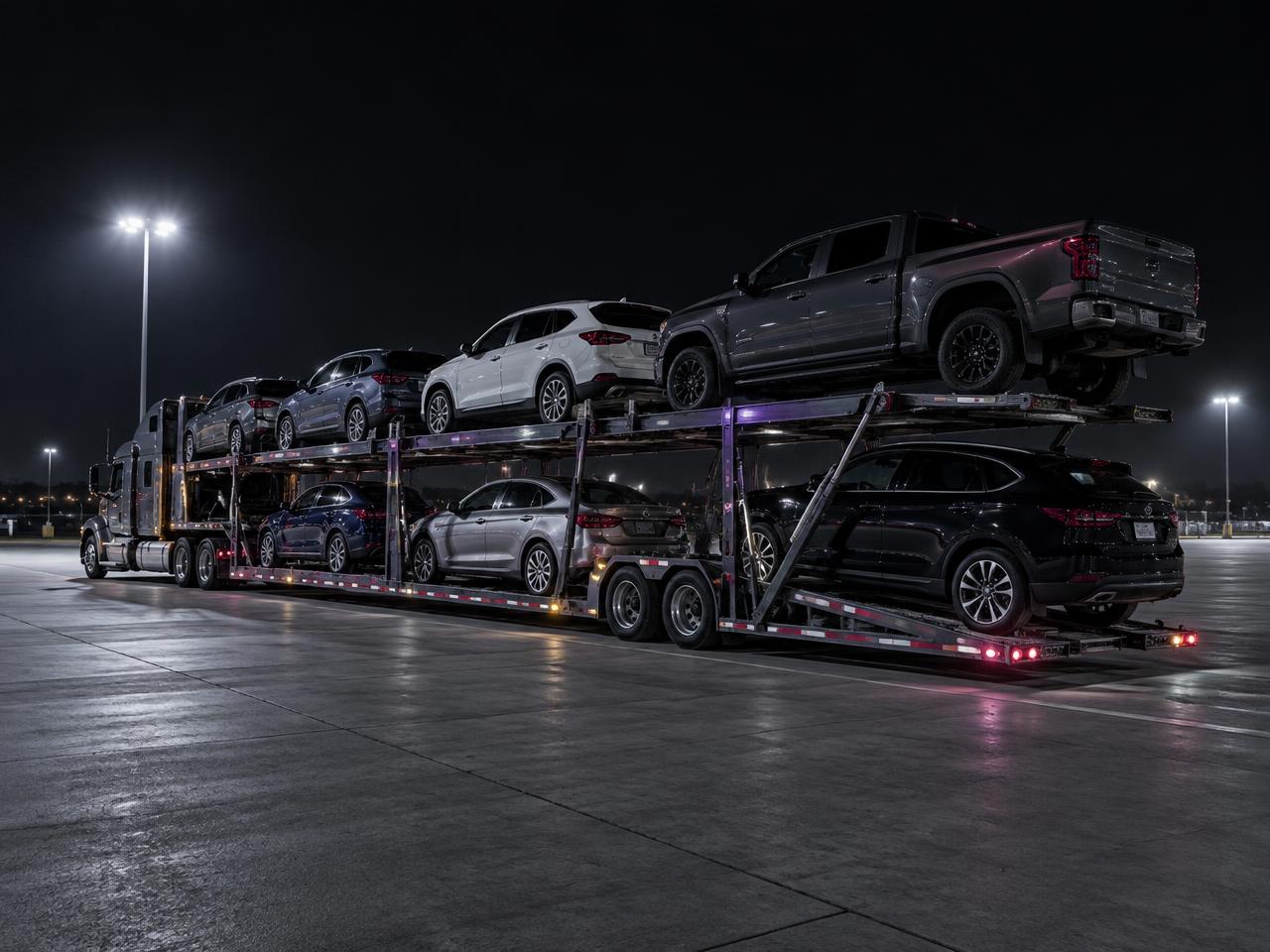
Open multi-car trailers
This is the most common equipment in the industry: a multi-level trailer that carries several vehicles at once, exposed to the open air. It's the setup most people picture when they think of car shipping, and the one used for the large majority of everyday shipments. Vehicles are secured individually with straps or chains at the wheels, and the trailer's design allows carriers to load a mix of vehicle sizes efficiently across a single run.
Enclosed soft-side trailers
Enclosed trailers protect vehicles from road debris and weather by fully covering them, and soft-side versions use a heavy-duty fabric or vinyl covering over a frame rather than solid panels. They're generally lighter than hard-side enclosed trailers, which can be a factor in carrier routing and availability, while still shielding the vehicle from the elements during transit.
Enclosed hard-side trailers
Hard-side enclosed trailers use rigid metal or composite walls, offering a fully closed environment for the vehicle inside. These are typically used for higher-value, classic, or otherwise sensitive vehicles where full weather and debris protection is a priority. Hard-side trailers often carry fewer vehicles per load than open carriers, which is one reason enclosed transport is typically requested specifically rather than being the default option.
Single-car and hotshot trailers
Single-car trailers, sometimes paired with a hotshot-style truck (a heavy-duty pickup pulling a flatbed or gooseneck trailer), carry just one vehicle at a time. This setup is often used for shorter routes, specialized vehicles, or situations where a dedicated single load makes more sense than waiting for space on a multi-car carrier. Availability for this type of equipment varies by region and route.
Top load vs. bottom load positioning
On a multi-level open trailer, vehicles are loaded in either a top position (upper deck) or bottom position (lower deck). Top load positions generally offer more protection from road spray and debris kicked up from the highway, which is why some shippers request it specifically for a nicer or lower-clearance vehicle. Bottom load positions are typically easier and faster to load and unload. Requesting a specific position is possible but not guaranteed, since it depends on how a carrier's load is configured for a given run.
Winch-equipped trailers
Vehicles that can't be driven on and off a trailer under their own power, because they're inoperable, have very low ground clearance, or have other mobility issues, generally need a trailer equipped with a winch. The winch mechanically pulls the vehicle onto the trailer bed using a cable, avoiding the need for the vehicle to start or roll on its own wheels. If your vehicle can't be driven, mention this clearly when booking so a winch-equipped carrier can be matched to the job.
How equipment choice affects your booking
The type of trailer that ends up assigned to your shipment depends on your vehicle's needs, what you request, and what's available from carriers serving your route at the time of booking. Open transport suits the overwhelming majority of shipments well, while enclosed, single-car, or winch-equipped setups address more specific situations. Discuss what matters most for your vehicle with your coordinator so the request can be matched appropriately.
When you are ready, request a written quote or contact us with questions about your specific vehicle and route.
Velocity Auto Transport Group LLC is an auto transport brokerage. We arrange vehicle transportation through qualified motor carriers and coordinate your shipment from quote to delivery — the carrier assigned to your vehicle operates the truck.
How we work
What you can expect from us
We are a licensed-carrier brokerage, not a trucking fleet
Velocity Auto Transport Group LLC arranges your transport with qualified motor carriers. The carrier assigned to your vehicle operates the truck; we coordinate the booking, the paperwork and the updates.
Written quotes, reviewed by a person
Your route, vehicle and timing are reviewed against current carrier-market conditions before we send a quote. No instant algorithmic number that changes after you book.
One point of contact from quote to delivery
You reach the same team for scheduling changes, pickup windows and delivery updates rather than a call queue.
Questions
Common questions
No obligation — requesting a quote is free, and payment only applies once you accept an offer.
Get a quote
Ready for a straight answer on your route?
Tell us the route, the vehicle and its condition. We review current carrier-market conditions for that lane and come back with a quote we can actually stand behind.